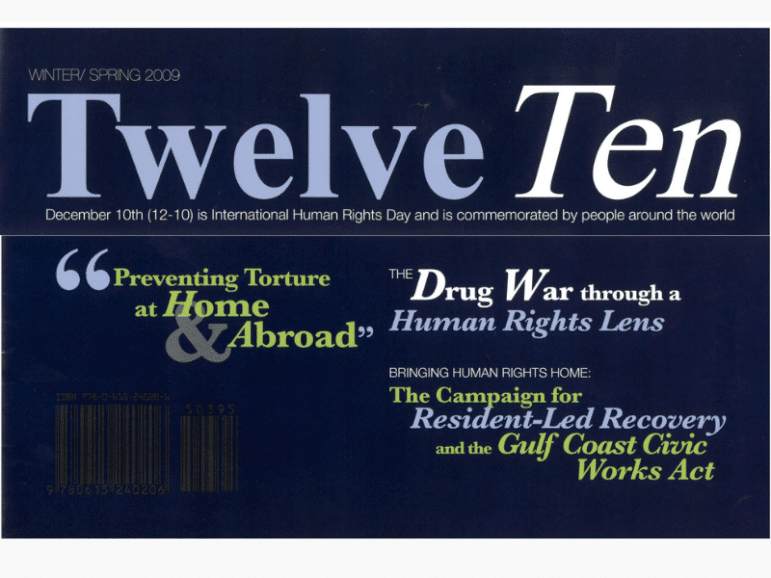
Published in TwelveTen: The Magazine of the U.S. Human Rights Network, Winter/Spring 2009
February 2009
By Jasmine Tyler, gabriel sayegh, and Vera Leone
“Just as Jim Crow laws were a successor system to slavery in the attempt to keep blacks subjugated, so drug prohibition has become a successor system to Jim Crow laws in targeting black citizens, removing them from civil society and then barring them from the right to vote while using their bodies to enhance white political power in Congress and the electoral college.” – Ira Glasser (2007)
“The treatment of addicts in the United States today is on no higher plane than the persecution of witches of other ages, and like the latter it is to be hoped that it will soon become merely another dark chapter of history.” – Alfred R. Lindesmith (1940)
The United States government’s war on drugs is a leading human rights issue here at home and around the world. The drug war is one of the fundamental mechanisms through which institutional racism operates in the U.S., and the war has had demonstrably negative impacts on public health, especially in communities of color and low-income neighborhoods. Despite costing taxpayers tens of billions of dollars every year, the war has failed to dent domestic drug use or availability. A new administration in the White House will decide whether to continue pursuing the failed war on drugs or move the country in a new direction. A human rights perspective can help us better understand the broad impact of this unwinnable war and guide communities and policy makers in crafting effective, workable alternatives.
THE DRUG WAR IN PRACTICE: A HUMAN CATASTROPHE
When 92-year-old Kathryn Johnston of Atlanta, Georgia, heard people creeping around in her yard, she grabbed her gun and prepared to defend herself against a possible home invasion. When the intruders kicked down her door, guns drawn, Ms. Johnston fired one shot and then died in a hail of police bullets. The intruders were police conducting a no-knock, SWAT-style raid in search of drugs they would never find. As one of the officers later admitted, the police then planted marijuana in her basement so they could accuse her of being a drug dealer. However, her community knew better, and the police fraud was subsequently exposed.
Officers arrested Ashley O’Donoghue in upstate New York in 2001 and charged him with a felony related to a cocaine deal. Ashley –African-American, 20 years old and from New York City — sold small amounts of cocaine to two white friends at Hamilton College. When his friends were busted for cocaine possession, they cut a deal with the prosecutor to entrap Ashley. The friends asked Ashley to transport a much greater quantity of cocaine by train, and upon Ashley’s arrival at the station, he was promptly arrested. Ashley was sentenced to 7-21 years in prison for this first-time, nonviolent offense. His two friends would have their records sealed and graduate college without a hitch.
When the HIV/AIDS crisis exploded in the 1980s, the sharing of used syringes among intravenous drug users was identified as a significant contributor to the spread of the blood-borne disease. In Europe, public health workers and active drug users began to distribute sterile syringes as a means to slow the spread of the virus, and activists in major U.S. cities followed suit. Studies found that syringe exchange reduced the spread of HIV/AIDS and hepatitis C, did not promote drug use, and often put drug users in contact with much-needed health services. Nevertheless, many cities and states in the U.S. banned syringe exchange programs and arrested exchange workers. Public attitudes shifted in the late 1980s and 1990s, and some cities and states began to facilitate syringe access.
Despite scientific consensus that syringe exchanges reduce the spread of disease, however, the U.S. government still maintains a federal ban on funding syringe exchanges. And some states, like Texas, continue to prosecute people who distribute sterile syringes-people like 72-year-old minister Bill Day from San Antonio, who was arrested in January of 2008 on drug paraphernalia charges.
In each of these instances, human rights violations are directly linked to the nation’s longest-running war, the war on drugs. Though drug prohibition in the U.S. officially began in 1914 with the passage of the Harrison Act, our modernday drug war was reinvigorated in the early 1970s by President Richard Nixon. More than 35 years later, a human rights perspective on drugs and drug addiction remains almost entirely absent from government policies, and the disastrous consequences of this war continue to mount.
RACIAL DISPARITIES IN THE U.S.: THE HEART OF THE DRUG WAR
The ravages of the domestic drug war are rarely viewed as human rights violations.
If one needs convincing, a quick overview of the U.S. prison industrial complex should suffice. The United States holds just 5 percent of the world’s population yet incarcerates 25 percent of all the world’s prisoners. Nearly 2.6 million people are incarcerated in U.S. prisons and jails, and more than seven million people are under some form of criminal justice supervision (such as parole or probation). For perspective, consider that in the U.S., nearly half a million people are locked up on drug charges alone –the vast majority of them nonviolent– compared with about the same number of people incarcerated in European Union nations for all offenses combined, even though the European Union has almost 200 million more residents than does the U.S.
According to various government and independent reports, more than $40 billion per year is spent to prosecute the seemingly eternal war on drugs. The outcome? FBI statistics show that there were more than 1.8 million drug arrests in 2007– three times the arrest rates for violent crimes. Approximately 75 percent of all drug arrests were for simple drug possession. Drug availability and drug use remain relatively constant despite the massive investments to make the U.S. a “drug-free” nation.
Mandatory minimum sentence laws passed by tough-on-crime politicians have also contributed significantly to the prison population explosion. Mandatory minimums strip judges of their discretion, give prosecutors unfair power in an “impartial” court, and require unduly long prison sentences for minor offenses, violating common sense and fundamental notions of justice and morality.
The most egregious example of mandatory minimum sentencing (and the most well-known example of the institutional racism built into the drug war) is the sentencing disparity between crimes involving crack vs. powder cocaine. In 1986, Congress enacted a federal law that punishes crack cocaine offenses 100 times more severely than for those involving powder cocaine despite the fact that the two substances have similar physiological effects. The 1986 and 1988 Drug Abuse Acts mandated that simple possession or distribution of just five grams of crack cocaine, equivalent to a few sugar packets, result in a five-year mandatory minimum sentence. In sharp contrast, it takes 500 grams of powder cocaine to trigger the same mandatory sentence.
The U.S. Sentencing Commission found that about two-thirds of crack cocaine defendants in 2006 were low-level users and only 1.8 percent were high-level suppliers. In 2006, African-Americans constituted 82 percent of those arrested under federal crack cocaine laws while whites constituted only 8.8 percent. In contrast, whites and Hispanics accounted for 72 percent of powder cocaine arrests. Crack cocaine sentences that year were 43.5 percent longer than powder cocaine sentences; the average length of imprisonment for powder cocaine offenders was 84.7 months, while crack cocaine-related imprisonments averaged 121.5 months.
Moreover, according to the Office of National Drug Control Policy and other drug policy agencies, whites use and sell illegal drugs at the same proportional rates as people of color, yet the risks of incarceration multiply exponentially for the latter. Nearly 75 percent of those incarcerated in state prisons for drug offenses are African-American and Latino. The unconscionable racial disparities resulting from the drug war painfully illustrate how this war remains one of the last legal vestiges of Jim Crow laws in the U.S. today.
Institutional racism is similarly evident in the policing of drug violations. Drug prohibition policing has produced no-knock warrants and violent raids, widely reported racial profiling problems, rampant police abuses of due process and even killings. For example, in Tulia, Texas dozens of African-American residents were sentenced to decades of prison time based solely on the uncorroborated testimony of one undercover white officer. And in Dallas, dozens of Latino men were imprisoned or deported because of an undercover police operation that involved officers planting ground sheetrock on the men and claiming it was cocaine.
THE DRUG WAR’S GLOBAL IMPACT
The impact of the drug war on human rights reaches far beyond the borders of the U.S. In the 1990s, Colombia became the third largest recipient of U.S. foreign aid, most of which was used for anti-drug efforts. The aid package originally incorporated economic and social aid but became heavily slanted toward military support to bolster the Colombian government’s efforts against leftist guerrillas under the guise of Andean anti-narcotics efforts.
Since September 11 the plan has also included a so-called anti-terrorist rationale. According to the Center for International Policy, almost $5 billion in U.S. taxpayer dollars have been allocated to Plan Colombia since 2000, and the majority of that funding has been dedicated to military training, equipment and contracts for the Colombian military to fight “narco-terrorism.”
This aid from the U.S. has resulted in innumerable human rights violations throughout Colombia and the Andean region. Aerial fumigations supposedly targeting coca crops have harmed civilians and children; ravaged legal food, flower crops and animals; and had enormous environmental consequences in a country renowned for its rich biodiversity. The eradication program has forced many residents from their homes, threatened virgin forests and wildlife habitats, and spread conflict. Innocent civilians, especially in rural areas, have been caught in the crossfire between right-wing paramilitary organizations supported by the Colombian government and various guerrilla factions, and children are often recruited by force into one or another of the armed groups. Social organizations such as unions, women’s organizations, and campesino (farming) collectives are especially targeted. The COSURCA farmers’ collective, for instance, has been a shining example of alternative development, but the collective’s farms were fumigated in 2005 and again in 2007, their crops destroyed and their organic certification forfeited. COSURCA still has not been compensated for their losses.
Despite the billions of dollars in U.S . funding dumped into the Colombian conflict, the acreage of coca being grown and eventually shipped out of Colombia has actually increased over the last 10 years. The non-profit research firm RAND Corporation found drug treatment domestically to be 23 times more cost-effective than trying to eradicate drugs at their source. Despite this, the U.S. State Department is pushing heavily for similar programs in Afghanistan and Mexico. The Senlis Council, a leading international policy research institution in Afghanistan, produced a strong critique of that policy and offered an alternative in a report released earlier this year. Senlis recommends that the U.S. stop short-term poppy crop eradication, especially via aerial fumigations, and instead focus on alternative rural development.
A MODEL FOR CHANGE
The new administration in Washington, D.C. will need fresh ideas and effective policy proposals to address the deplorable human rights problems resulting from the failed war on drugs in the U.S. and beyond. Fortunately, there are proven alternatives in use today in the U.S. and around the world, perhaps the most important of which is harm reduction. This approach is embodied in the Four-Pillars Drug Strategy, widely employed in Europe and Canada.
Four Pillars, the official policy of Switzerland, is a coordinated, comprehensive approach that balances public order and public health in order to promote human rights and create safer, healthier communities. The first pillar, prevention, aims to protect child and youth development by preventing or delaying the start of substance use among young people, reduce the harm associated with substance misuse, and to promote healthy families and communities. By providing real drug education, moving beyond zero-tolerance policies and rejecting scare tactics, parents and educators can build trusting relationships with young people and help guide them through fact-based decision-making about drugs.
The second pillar ensures that substance abuse treatment is available to all who need it, whenever they need it, and as often as they need it. As many as 10 million Americans suffering from alcohol or other drug dependencies each year do not receive needed substance abuse treatment. U.S. citizens must advocate for an increase in federal, state and local funding to provide treatment for more people, including mental health services that address the root causes of addictive behavior. Cities like Milwaukee have been providing people who need treatment with vouchers redeemable for treatment services from the program of their choice. By offering individuals access to. services that allow them to come to terms with substance use and lead healthier lives (such as outpatient and peer-based counseling, methadone programs, daytime and residential treatment, housing support and ongoing medical care), the U.S. can dramatically reduce the economic and social costs of substance abuse.
The third pillar, effective public safety strategies, concentrates law enforcement resources on those individuals and institutions that pose the greatest threat to public safety-starting with those who commit violence, steal to support their habits or drive while impaired. Current policing practices often obstruct these goals by focusing on low-level drug users as a means to achieve arrest quotas. As many as 40,000 no-knock SWAT-style raids are conducted by police and paramilitary units in the U.S. each year with disastrous consequences for communities of color. Law enforcement could easily use existing resources to improve public safety by shifting the public health burden to appropriate public health agencies. Police must stop arresting people enrolled in syringe exchange ‘programs-especially those programs that local authorities have legalized and encouraged-and stop· arresting drug users who call 911 when a companion is overdosing. “Good Samaritan” immunity laws would help eliminate the fear that often causes critical delays in summoning help after witnessing a drug overdose. To the greatest extent possible, law enforcement should build partnerships with the public, helping drug users find public health services and working with citizens to protect public safety. Because treatment, prevention and other public health strategies have not received adequate funding, the brunt of addressing drug use and its associated harms has fallen on the shoulders of state and local law enforcement agencies. Policymakers need to treat drug abuse as a public health issue of which criminal justice is only one component, not the overarching framework.
Harm reduction, the fourth pillar, is a public health strategy designed to reduce the harms associated with unsavory activities. One of the best-known examples of a drug-related harm reduction strategy is parental instruction– for example, telling their teenagers to call home for a ride if they are ever intoxicated or in the car with someone who is, no questions asked. While there are many harm reduction strategies that could minimize the risks associated with drug misuse, the most urgent need is to address threats to public health.
Each year, about 12,000 Americans contract HIV/AIDS directly or indirectly from the sharing of dirty syringes, and about 17,000 contract hepatitis C. Attempts to decrease the spread of deadly communicable diseases; prevent drug overdose deaths; increase drug users’ contact with health care services and drug treatment programs; and reduce drug consumption in the street are imperative. Increasing the availability of sterile syringes through needle exchange programs, pharmacies and other outlets reduces unsafe injection practices, curtails transmission of disease, increases safer disposal of used syringes and helps intravenous drug users obtain drug education and treatment. Virtually every established medical and scientific body that has studied the issue agrees that improved access to sterile syringes would help reduce the spread of infectious diseases. Policymakers at all levels should make sterile syringes widely available and increase funding for safer-injection education programs, and the federal government should immediately repeal the ban on using federal HIV/AIDS prevention money on syringe exchange programs.
CONCLUSIONS
When a new administration enters the White House next January, it will face a daunting array of challenges related to our nation’s war on drugs-a bloated, overcrowded prison system; rising HIV/AIDS and Hepatitis C infections; increased accidental drug overdoses; stark racial disparities in our criminal justice and public health systems; and an international crisis stemming from an unrealistic global “anti-drug” crusade. The new administration should employ a human rights framework to guide policy alternatives that will help reduce the death, disease, suffering, and waste associated with both drug misuse and failed drug policies.
For more information about the war on drugs, and what you can do to help, please visit www.drugpolicy.org.
Jasmine Tyler, Deputy Director, Drug Policy Alliance Office of National Affairs. As deputy director of national affairs, Jasmine Tyler works as a federal lobbyist on diminishing the harms associated with drug use and the drug war. Before joining the organization, Jasmine worked as research director for the Justice Policy Institute, where she co-authored several reports, including “Higher Education Programs in Prisons: Promoting Public Safety and Building Social Capital,” “Cost-Effective Corrections: The Fiscal Architecture of Rational Juvenile Justice Systems,” and contributed to “The Consequences Aren’t Minor: The Impact of Trying Youth as Adults and Strategies for Reform.” Prior to working for JPI, Jasmine was a sentencing advocate and mitigation specialist at the O.C. Public Defender Service and the Fairfax Public Defender Office. She received a B.S. in sociology from James Madison University and an M.A. in sociology from Brown University.
gabriel sayegh, Director, Drug Policy Alliance State Organizing and Policy Project. Prior to joining the organization in 2003, Sayegh worked in the Washington State Senate; was a volunteer organizer in the Northwest on issues related to global trade and racism; and was a researcher focused on global trade, the prison system and domestic welfare reform. sayegh has developed numerous political training programs and educational curricula, including the Olympia Antiracism Workshop and anti-domestic violence/healthy relationship programs for secondary and middle school students in California. He is a resident of Brooklyn, NY
Vera Leone, Drug Policy Alliance Internet Communications Associate. Vera Leone, from Rochester, NY and rural Arkansas, she received a Bachelor’s degree Guilford College. While there she led local organizing efforts in the campaign to shut down the Schoof of the Americas/Western Hemisphere Institute for Security Cooperation (SON WHINSEC), and served a six-month prison sentence for civil disobedience at Ft. Benning, GA, where the SONWHINSEC is located. Spending time locked up with women largely incarcerated because of the Drug War, Vera has been interested in challenging those unjust policies ever since. She is currently pursuing a graduate degree in lntercultural Service, Leadership and Management from the SIT Graduate Institute in Brattleboro, VT. Research and social justice interests include anti-oppression organizing and building relationships of solidarity and accountability with those who are directly affected by racist systems of violence and oppression.